Shantou Open University
Fundamentally speaking, the use of technology in education is to enhance educational quality, and in the case of open and distance education (ODE) institutions, primarily to assure quality and broader access, leading to new models of learning and teaching. As more and more sophisticated and powerful digital technology is integrated into the world we inhabit, digital technology is now taken to be a holy grail by ODE institutions that are keen to digitally transform their institutional operations in hopes of enhancing and assuring quality as well as maintaining competitive advantage in widening access.
In “Digital Transformation Signals: Is Your Institution on the Journey?”, EDUCAUSE defines digital transformation as “a series of deep and coordinated culture, workforce, and technology shifts that enable new educational and operating models and transform an institution’s business model, strategic directions, and value proposition.” Therefore, it is self-evident that simply using technology in education, no matter how cutting- edge it is, does not lead to digital transformation, as is best exemplified by traditional dedicated ODE institutions.
Ever since their establishment, ODE institutions have distinguished themselves from conventional higher education (HE) institutions not merely by their technology-enhanced means of delivery. They are distinct in many other aspects, including “business model, strategic directions, and value proposition”, among other things. An explicit message from the history of ODE institutions is that the transformation of an education system involves a systemic change whereby change in an element is experienced by the whole system, most probably catalysing reactions in other elements. This systems approach to ODE was first adopted by Charles Wedemeyer in his Articulated Instructional Media project in America in the 1960s. It was later further developed and elaborated by Michael G. Moore in his distance education theory. The systems theory informed the foundation of the Open University in the UK (OUUK) and subsequently the establishment of other open universities around the world.
This is a lesson that should be valued but unfortunately tends to be neglected today, not only by conventional HE institutions seeking to take advantage of digital technology but also by ODE institutions themselves. Reviews of research in ODE including educational technology have repeatedly indicated that the field is characterised by one-off, short-duration, isolated studies. Given that digital transformation implicates systemic change, a systems approach to ODE research and practice is essential to ensuring the generation of meaningful research results and the productive application of these results to practice. This argument is echoed by Professor Mike Sharples at the OUUK. He made a case for a systems approach to AI in education in his 2025 paper “A Systems Approach to AI and Education in a Post-Digital World”.
“Taking a piecemeal approach in adapting to an AI-infused future (for example, regulating how students must use AI in their assignments, or attempting to reduce staff workload by introducing AI into the administration process) is unlikely to be successful. Education is a strongly interconnected system, with many mutually dependent components, including recruitment, registration, teaching, student support, assessment, careers, and administration,” says Sharples.
Drawing upon the Russian-born American psychologist Urie Bronfenbrenner’s Ecological Systems Theory, Mike Sharples proposed a systems approach to AI and education in a post-digital world, an approach that is intended to show the various layers of interaction centred on a student in formal education. According to the embedded systems approach, the student is situated in four layers of systems. The innermost is the microsystem (e.g., class, materials and exams) which is surrounded by the mesosystem (e.g., library, calendar, student community, labs, and meeting rooms), the macrosystem (e.g., admissions, student services, procurement, quality assurance, IT support, career advice, and staff training), and the exosystem (e.g., internships, social media, technology companies, government regulations, educational technology vendors, careers, and education providers). These four systems are concentric. According to Mike Sharples, “[e]ach layer interacts with and depends on others, so changing one component affects the entire system.” For example, adopting a new technology “will impact IT support, staff training and workload, procurement, design of teaching materials, exams, quality assurance, and so on.”
Mike Sharples then listed ten agendas with respective key actions for education institutions of all types (see Table 1). He argues that education institutions must adopt an embedded systems approach to educational innovation in order to survive and prosper in an AI-infused world.

| Agenda | Key Actions | |
|---|---|---|
| 1 | Build awareness and leadership support |
|
| 2 | Map the institution as a system |
|
| 3 | Define innovation goals |
|
| 4 | Identify leverage points |
|
| 5 | Foster collaborative cultures |
|
| 6 | Develop iterative processes |
|
| 7 | Build systems thinking capacity |
|
| 8 | Use data for decision-making |
|
| 9 | Institutionalise systems thinking |
|
| 10 | Commit to continuous learning |
|
Table 1: The agendas and key actions of a systems approach to AI and education
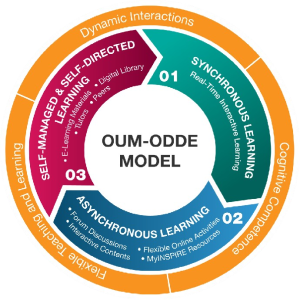
OUM’s Teaching & Learning Ecosystem, also known as evolved ODDE model (see Figure 1), and its Strategic Research Alliances (SRAs) initiative are highly aligned with systems thinking, in particular the embedded systems approach proposed by Sharples. With forty years’ experience as a practitioner and researcher in ODDE, I find OUM’s evolved ODDE model to be a particularly thoughtful and well-conceived framework. I first learnt about this model from Dr David Lim’s interview with Professor Datuk Dr Tajudin Md Ninggal, OUM Vice President (Academic & Research) (see inspired, issue 24). This evolved ODDE model is informed by proven theories of pedagogy, psychology, and instructional design with the aim of prioritising and meeting individual needs to optimise learning outcomes. Educators and students are at the centre of the model. It bears testimony to OUM’s philosophy of digital humanism.
The OUM model is composed of two rings. In the inner ring, learning is facilitated in three modes: synchronous (e.g., real-time interactive learning), asynchronous (e.g., forum discussion, flexible online activities, interactive content, and myINSPIRE platform resources), as well as self-managed and self-directed (e.g., E-Learning materials, digital library, tutors, and peers). In the outer ring, dynamic interaction, cognitive competence, and flexible teaching and learning interact to ensure that the three learning modes in the inner ring will reinforce one another to produce the optimal learning outcomes. Obviously, there is unequivocal evidence of systems thinking embodied in the OUM model. And similar to Mike Sharples’s systems approach to education, it is student-centred.
In early 2024, OUM launched its SRAs, a flagship research initiative. The initiative emerged from a retreat held in early December 2023, where 30 active academics came together to shape the future direction of research at OUM. It is organised around macro-, meso-, and micro-level issues that reflect OUM’s institutional priorities as well as emerging research themes in the broader ODDE landscape. The SRAs represent OUM’s concerted investment in research, focusing on key challenges to be addressed through scholarly inquiry. Addressing these challenges is expected to contribute to OUM’s long-term sustainability and continued development.
More specifically, the four major strands of research, namely Technology Integration and Innovation, Inclusive Education and Business Sustainability, Quality Education, and Psychological and Spiritual Wellbeing and Environmental Sustainability, aim to bridge the digital divide, foster equity and resilience, enhance learning outcomes, and build holistic and sustainable futures respectively. Each alliance has five sub-research groups tasked with exploring specific subthemes. These alliances encourage collaboration across faculties and disciplines, making them interdisciplinary by nature, and all academics are expected to participate in at least one sub-research group. “By bringing together diverse stakeholders – academic teams, industry leaders, and global partners – and providing multifaceted support, the SRAs aim to foster synergies that address pressing real-world challenges,” says Prof Tajudin.
If we map OUM’s ODDE model and SRAs against Table 1, we can easily see that OUM is taking an embedded systems approach to building a digital university for all. There is ample evidence that OUM has done well in at least six aspects, namely building awareness and leadership support, mapping the institution as a system, defining innovation goals, identifying leverage points, fostering collaborative cultures, and committing to continuous learning. There is no doubt that with the implementation of SRAs, there will be progress in developing iterative processes, building systems thinking capacity, using data for decision-making, and institutionalizing systems thinking.
We can argue convincingly that OUM is advancing in the right direction towards the kind of digital transformation that aligns with both the general and institution-specific missions and goals of ODDE. Both top-down and bottom-up efforts are effectively mobilised to ensure the successful delivery of predefined goals, with notable achievements already made in numerous areas. To the best of my knowledge, OUM is among the few, if not the only one, that adopts a systems approach, with practice and research informing and reinforcing each other, in pursuing its ambition to be a leader in the national, regional, and international ODDE communities.
A word of caution might be necessary, though, for those ODDE institutions that appear to be (over)optimistic about the role of technology per se in driving transformation and tend to underestimate possible obstacles ahead. For example, while endorsement from senior management and buy- in from the grassroots are essential, equally imperative are, inter alia, institutional and individual stakeholders’ expertise in implementing innovations, fit-for-purpose infrastructure, and substantial institutional commitment. These are lessons learnt from the OUUK’s recent high-profile project: the design, development, deployment, and evaluation of an in-house Artificial Intelligence Digital Assistant (AIDA). A paper published in May 2026 presents an overview of this two-year longitudinal research. Authored by Professor Bart Rienties and three other OUUK researchers, “New systems of learning for distance learning institutions? A six-study review of implementing AIDA” is worthwhile reading for colleagues engaged in ODDE transformation in the post-digital age.
Copyright © Open University Malaysia 2018 – 2026 inspired All Rights Reserved.
No part of inspired may be reproduced in any form or by any means without the written consent of the Editor of inspired.